
230 V / Mains (AC) T8 LED tubes
Filter inCategory
Too much choice?
Find the product in 3 steps!
Help me choose!
Current refinements:
Only in Stock
Length
Explanation
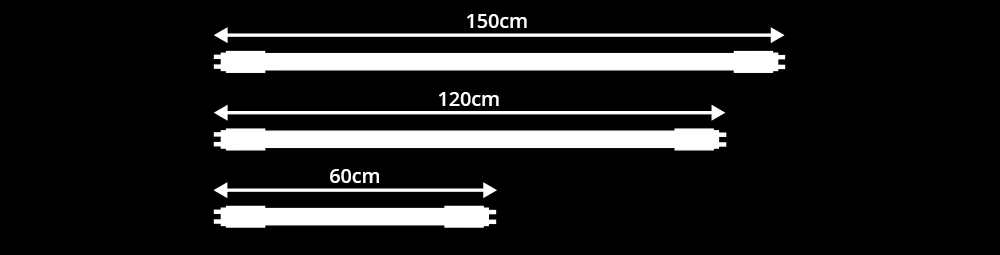
The most common lengths for T8 LED Tubes are 60cm, 90cm, 120cm and 150cm. For T5 LED Tubes this concerns 55cm, 85cm, 115cm and 145cm. Switching to LED? Then always check the length of your current fluorescent lighting. Do you want to know more? Then read our blog!

Colour Code
Explanation
The colour code is a combination of colour rendering (CRI) and light colour (Kelvin). The first number indicates the colour rendering (1 = very poor colour rendering, 9 = maximum colour fastness). The second and third number contains the light colour. Example: the colour code 830 consists of good colour rendering (8) and warm white light (3000K).
Replaces (Watt)
Explanation
This indicates which wattage of your old/conventional lighting is replaced by this LED product.
LED Tube Output
Explanation
High Output - Gives higher lumen output vs standard tube
Standard Output - average lumen output
Ultra Output - Highest Lumen out, ceiling must be over 4 metres
High Efficiency - High lumen lumen / watt ratio
Ultra Efficiency - LED tubes with best energy label (A + B)
Standard Output - average lumen output
Ultra Output - Highest Lumen out, ceiling must be over 4 metres
High Efficiency - High lumen lumen / watt ratio
Ultra Efficiency - LED tubes with best energy label (A + B)
Luminous Flux (Lumen)
Explanation
The number of lumens (lm) is the light output of a light source. The higher the number of lumens, the more light the light source emits. The wattage and the number of lumens are not connected to each other. An LED lamp with a low wattage can have a higher number of lumens than a conventional lamp with a high wattage.
Dimmable
Explanation
Dimmable bulbs work in combination with a dimmer switch and allow you to determine the desired light output. Dimming also provides energy saving potential because less power is required when the lamp is producing less light.
LED Starter included
Explanation
You need a LED starter if the fluorescent lighting in your current fixture also contains a starter. In that case, you have a fixture with a conventional ballast (EM). A LED starter replaces your current starter and ensures that a LED tube works.
Wattage
Explanation
The wattage indicates how much energy a light source consumes. With LED lighting, the wattage is considerably lower than with conventional lighting. LED lamps with a higher wattage generally also have a higher light intensity (number of lumens).
Housing
Series
Brand
Show products
